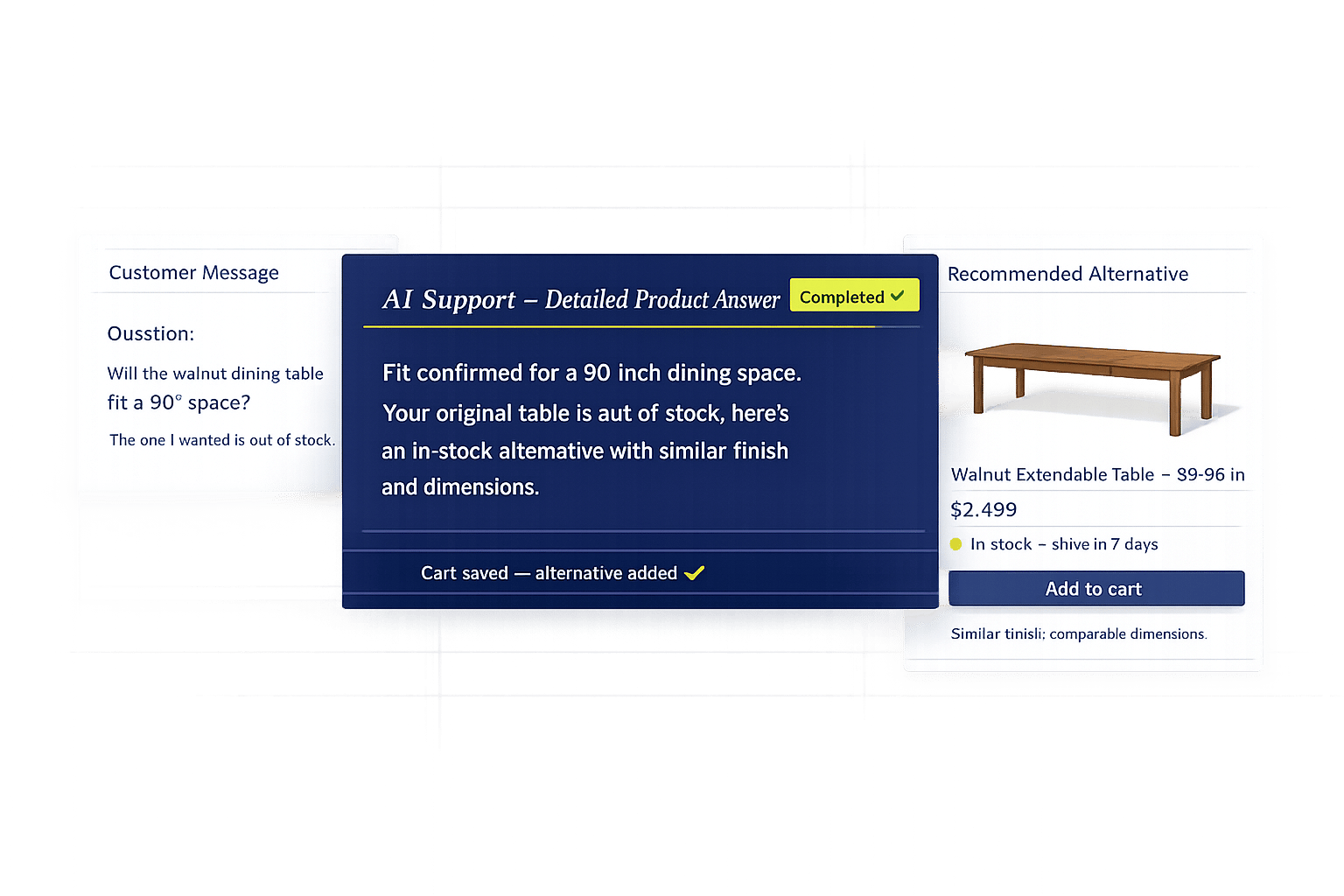
AI Support for High-Ticket Ecommerce Brands
AI support solves a critical problem for high-ticket ecommerce brands: answering product questions quickly and accurately. Shoppers buying expensive items like luxury apparel or electronics often abandon their carts if they don’t get answers fast.
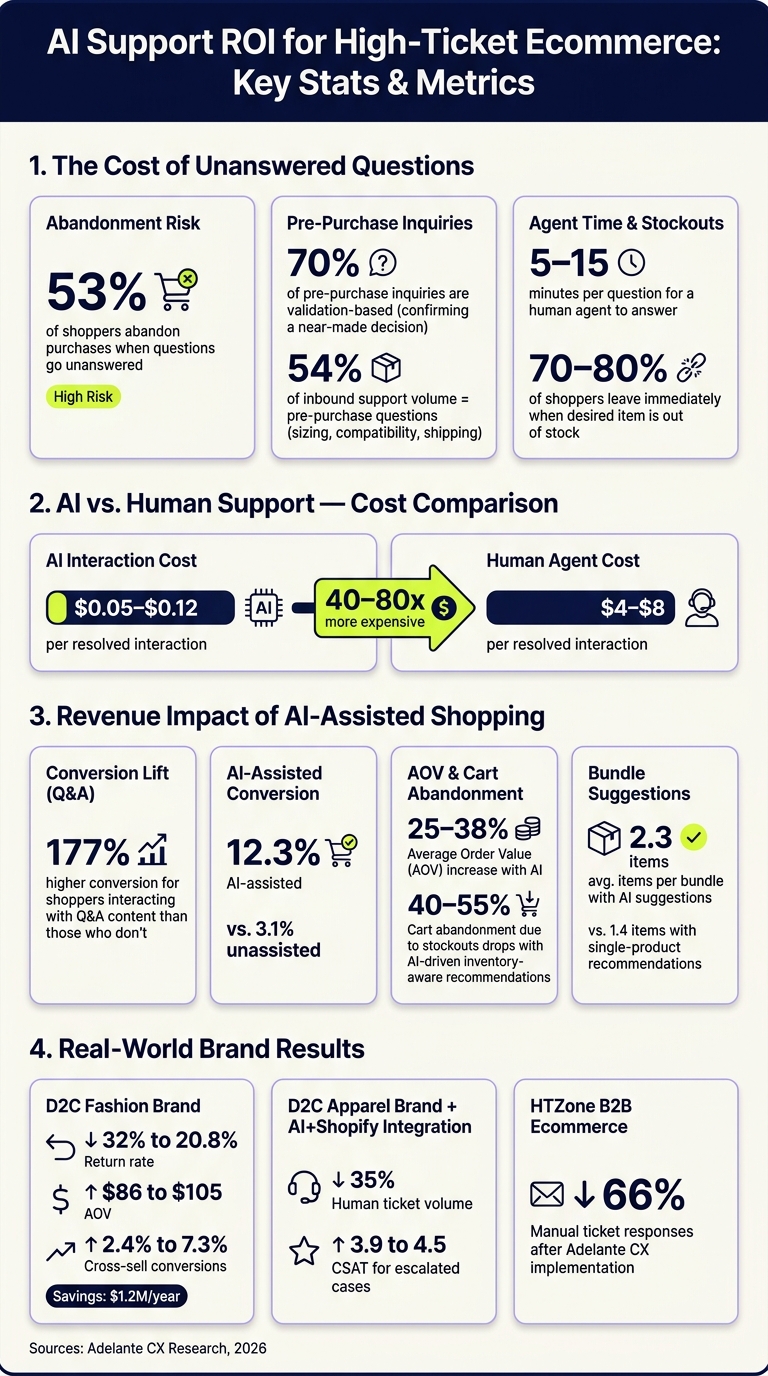
Why does this matter? Unanswered questions cost sales. Over 50% of shoppers leave when their questions go unanswered, and 70% of pre-purchase inquiries are validation-based - customers confirming a decision they’ve nearly made. Slow responses or incomplete answers turn high-intent buyers into lost opportunities.
Here’s what you need to know:
- High-ticket shoppers expect detailed, real-time answers about size, compatibility, and features.
- Questions are often specific and require tailored responses, not static FAQs or generic chatbots.
- AI tools reduce cart abandonment, increase conversion rates, and lower return rates by offering sales-assist and support resolution through instant, accurate guidance.
What should you do? Invest in AI that understands intent, integrates with your product catalog and inventory, and provides personalized recommendations. This ensures customers get the answers they need to complete their purchase, protecting revenue and improving the shopping experience.
Let’s break down how AI works for high-ticket ecommerce and why it’s essential for scaling support without losing sales.
AI Support ROI for High-Ticket Ecommerce: Key Stats & Metrics
The Problem: Product Questions Are High-Intent Sales Moments
When a shopper is browsing a $1,200 standing desk or a $400 pair of running shoes, they’re not just casually looking around. By the time they’ve reached a product detail page, they’ve already narrowed down their choices. At this stage, even a single unanswered question - about size, compatibility, or features - can be the only thing stopping them from completing their purchase.
This isn’t just a customer support issue; it’s a critical sales moment. Slow or incomplete answers can have a big impact - 53% of shoppers abandon their purchase when their questions go unanswered.
Common Pre-Purchase Questions in High-Ticket Ecommerce
Before buying, shoppers tend to ask three types of questions:
- Factual: Straightforward details like weight, materials, or dimensions.
- Contextual: Personalized inquiries, such as "Will this fit my current setup?"
- Comparative: Questions that help decide between two options, like comparing SKUs or configurations.
Interestingly, about 70% of these questions are validation-based - they’re not exploring options but confirming a choice they’ve almost made.
For instance: "Does this jacket run small?" "Will this supplement fit into my current routine?" "Is the 65-inch version compatible with my wall mount?" These aren’t things a static FAQ can handle effectively. They require tailored responses, and failing to provide them can delay or derail a purchase entirely.
What Poor Product Support Costs You
The financial impact of unanswered questions is clear and measurable. Shoppers who interact with Q&A content on product pages convert at rates 177% higher than those who don’t. Fast and accurate answers - especially about things like sizing - can double conversion rates compared to situations where customers have to wait for a human response. Without these answers, shoppers leave.
"We are not losing customers because our product is bad. We are losing them because we make them wait." - Director of CX, Apparel Brand
Beyond lost revenue, there’s also the operational burden. Pre-purchase questions about sizing, compatibility, or shipping make up as much as 54% of inbound support volume. Answering these manually can take 5–15 minutes per question for an agent. During busy seasons, this backlog can stretch response times from hours to days - far too long for shoppers who are ready to buy.
Even worse, many ecommerce metrics fail to track this loss. When shoppers abandon their cart because of an unanswered question, it doesn’t show up as a support ticket. Instead, it’s logged as a bounce, often misattributed to pricing or traffic issues. In reality, it’s an information gap on the product page. This highlights the need for an AI-powered solution that can provide instant, accurate answers to keep high-intent shoppers moving toward checkout.
sbb-itb-1d80ec1
How AI Product Recommendation Support Works
When shoppers are deciding what to buy, every second counts. Traditional tools like static FAQs, keyword-driven chatbots, and rule-based widgets often fall short because they focus on matching words, not understanding intent. Modern AI product recommendation systems take a different approach. They analyze what the shopper is actually trying to achieve and provide helpful, actionable responses. This speed and accuracy are especially important in high-value ecommerce, where hesitation can mean a lost sale.
What Ecommerce Product Recommendation AI Can Do
AI tackles product-related questions by blending semantic catalog search, real-time inventory updates, and contextual reasoning. For instance, if a shopper asks for a winter-appropriate rain shell, the AI doesn’t just look for matching keywords. Instead, it evaluates factors like waterproofing, breathability, and fit, checks current stock, and delivers a tailored recommendation. This approach minimizes abandoned carts, especially for high-ticket items.
An advanced AI system can even offer personalized size recommendations based on data like past purchases and return history. This avoids the generic "check the size chart" response. For example, a direct-to-consumer fashion brand with $15M in annual revenue introduced an AI size advisor in April 2026. As a result, their return rate dropped from 32% to 20.8%, and their Average Order Value (AOV) rose from $86 to $105. Cross-sell conversions also saw a significant boost, increasing from 2.4% to 7.3% during the same period.
Beyond individual products, AI can dynamically suggest bundles or complementary items, explaining why they work well together. These recommendations consider the shopper’s cart, use cases, and available inventory. Shoppers who receive these tailored bundle suggestions tend to add an average of 2.3 items to their cart, compared to just 1.4 items when shown single-product recommendations.
Here’s how AI recommendation tools compare to traditional systems:
| Capability | Traditional Widgets | AI Recommendation Agents |
|---|---|---|
| Query handling | Keyword matching | Intent-based reasoning |
| Inventory awareness | Often shows out-of-stock items | Real-time sync; in-stock only |
| Fit/sizing guidance | Generic size chart | Personalized based on history and return data |
| Bundle logic | Pre-defined static sets | Dynamic, cart-aware pairings |
| Conversion lift | Baseline | 10–20% increase within 90 days |
These features make AI a powerful tool for streamlining the entire product recommendation process.
Adelante CX: A Managed AI Layer for High-Ticket Brands
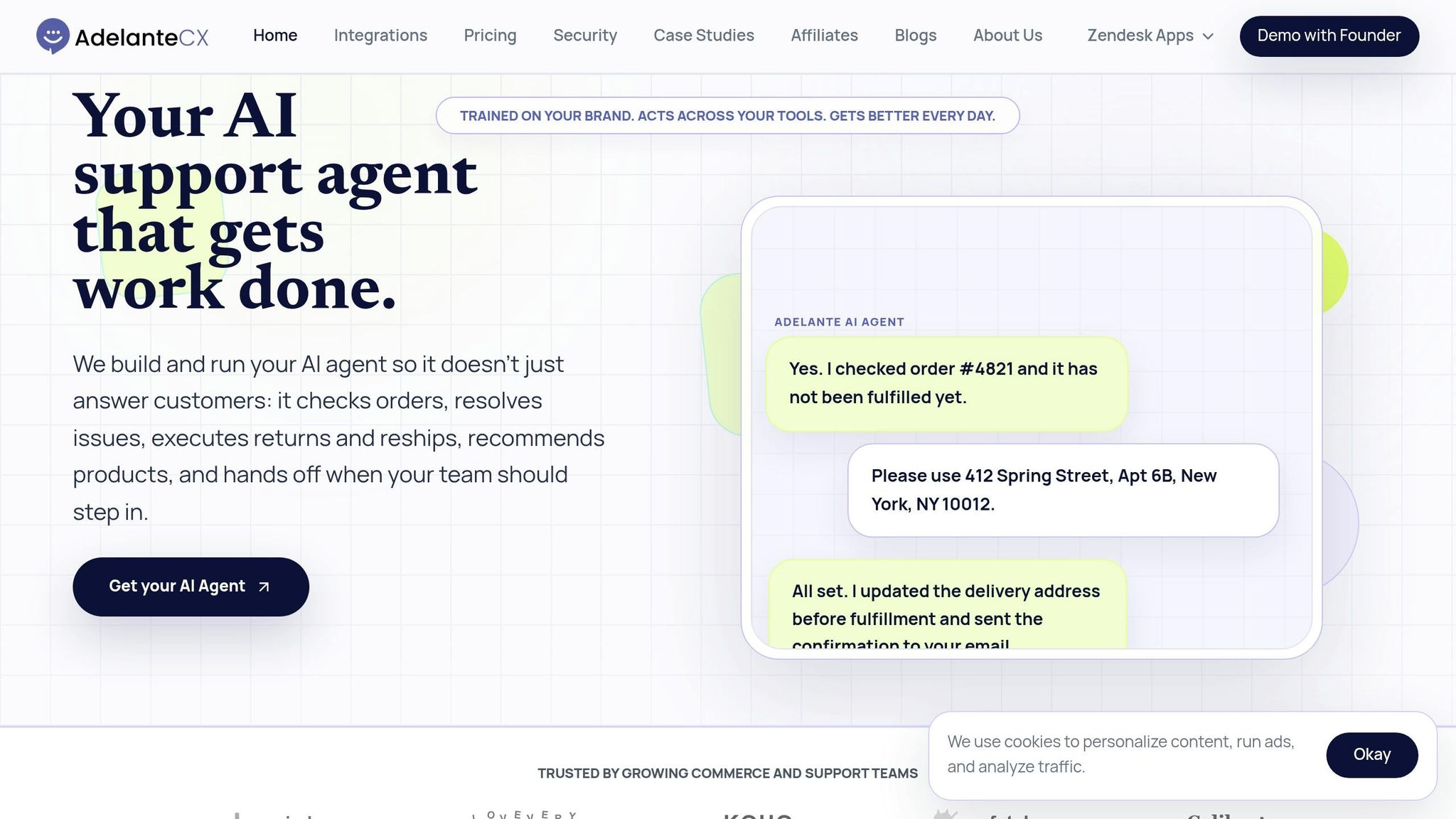
Adelante CX takes these capabilities a step further with a fully managed AI solution tailored for high-ticket ecommerce brands. It doesn’t just answer product questions; it automates the entire support workflow from start to finish.
Unlike many AI tools that require ongoing setup, training, and maintenance, Adelante CX is designed to minimize operational overhead. It integrates seamlessly with platforms like Shopify, WooCommerce, and Magento, as well as helpdesks like Zendesk and Gorgias. Once connected, it can handle tasks such as checking live inventory, applying product and policy rules, suggesting alternatives for out-of-stock items, and escalating complex queries to human agents with full context.
For example, HTZone, a B2B ecommerce company, implemented Adelante CX within their Zendesk system in 2026. The result? A 66% reduction in manual ticket responses by automating workflows for order tracking, returns, and product discovery.
"Adelante knows Zendesk inside-out and can take a customer's vision and provide an effective and smart solution. They introduced integrations that extend Zendesk's native capabilities." - Uri Ironi, VP (B2B Projects), HTZone
What sets Adelante apart is its ability to go beyond being just a chatbot. It’s a full system of action, managing everything from answering initial product questions to completing purchases - or handing off to a human agent when needed. This comprehensive approach ensures smoother, faster resolutions for both customers and support teams.
Revenue Protection: Saving the Sale When the First Choice Is Unavailable
When customers encounter out-of-stock messages, they often abandon their purchase altogether. Studies in high-ticket ecommerce reveal that 70–80% of shoppers leave immediately when their desired item isn’t available. To salvage these situations, offering timely alternatives becomes critical. This is where AI can step in, guiding customers toward comparable products that meet their needs.
How AI Recommends Alternative Products
Instead of simply displaying an out-of-stock message, AI searches the live catalog to find products that align with the shopper's original intent. It considers attributes like material, size, price range, and intended use. For instance, if someone is searching for a medium-sized waterproof hiking jacket, the AI will suggest similar jackets that match those criteria and explain why they’re relevant.
AI goes a step further by analyzing browsing behavior to detect style preferences, such as a tendency toward neutral colors or specific silhouettes. These personalized recommendations often help recover sales for high-ticket brands, offering alternatives at the exact moment customers might leave.
For expensive or complex items, adding fit confidence scores - like "95% confident this fits based on your order history" - can boost conversions on substitute items by up to 18%.
The accuracy of these recommendations hinges on real-time inventory data.
Real-Time Stock and Inventory Checks
AI recommendations are only effective if they’re based on accurate, up-to-date inventory. If the catalog updates only every few hours, the AI risks recommending items that are already sold out, frustrating customers and eroding trust.
Adelante CX solves this by integrating directly with ecommerce platforms like Shopify, WooCommerce, or Magento. This connection allows the AI to query live inventory before showing any recommendations. Every suggested product is confirmed to be in stock at the moment it’s displayed. Additionally, the AI can highlight genuine scarcity - such as "only 3 left in stock" - to encourage faster purchases without resorting to artificial urgency.
Merchants using AI-driven, inventory-aware recommendations report a 40–55% drop in cart abandonment due to stockouts. For high-ticket retailers, where a single sale can mean hundreds of dollars, this improvement has a significant financial impact.
| Feature | Impact on Revenue Protection |
|---|---|
| Real-time inventory sync | Prevents recommending unavailable items, ensuring a seamless shopping experience. |
| Attribute-based matching | Offers substitutes closely aligned with the shopper’s original preferences and needs. |
| Compatibility checks | Reduces returns by ensuring suggested components or variants work together. |
| Scarcity signals | Builds urgency and encourages checkout when stock is genuinely limited. |
How to Build an AI Support Workflow for High-Ticket Ecommerce
Setting up AI support for high-ticket ecommerce isn't just about technology - it's about ensuring your data is accurate and well-connected. The success of your AI depends heavily on the quality and accessibility of your data sources.
Data and System Requirements
Before diving into configuration, make sure these four key data sources are in place:
- Product Catalog: This includes details like product titles, descriptions, variants, tags, and metafields. It helps the AI answer questions about product features and fit.
- Live Inventory Feed: Provides real-time stock levels by location and variant, ensuring the AI doesn’t recommend items that are out of stock.
- Order History: Gives the AI the ability to offer personalized responses, track orders (WISMO), and identify VIP customers.
- Help Center Content: Contains resources like sizing guides, return policies, and FAQs, which the AI uses to handle pre-purchase and policy-related queries.
For example, improving a single knowledge base article raised AI accuracy on sizing questions from 71% to 96%. In one case, outdated help center content - not the AI setup itself - was the main issue. Rewriting just 40 out of 180 articles unblocked progress. Reviewing and updating your knowledge base is a critical step before launching, especially when moving beyond Chatbase vs. Adelante for full ecommerce resolution.
On the technical side, tools like Adelante CX integrate with platforms such as Shopify, WooCommerce, and Magento using read-only OAuth permissions. This allows the AI to securely query data like products, orders, and inventory. Real-time webhooks (e.g., products/update, inventory_levels/update) ensure the catalog stays updated within 30–60 seconds.
| Data Source | Key Fields | What It Enables |
|---|---|---|
| Product Catalog | Title, description, variants, tags, metafields | Helps with feature questions, fit guidance, and product recommendations |
| Inventory Feed | Stock levels by location and variant | Ensures accurate real-time availability checks |
| Order History | Status, tracking number, line items | Handles order inquiries, personalization, and VIP routing |
| Help Center | Sizing guides, return policies, FAQs | Addresses policy questions and fit concerns |
Human Handoff and Escalation
Even with solid data and effective AI, there will always be cases where human intervention is necessary. High-value returns, billing disputes, or frustrated customers often require a personal touch. To handle these situations, build clear escalation paths into your workflow. Triggers for escalation might include:
- Sentiment Detection: Flags frustration or negative tone in customer messages.
- Keyword Overrides: Directs customers to a human when they use terms like "agent" or "human."
- Value-Based Rules: Routes high-value cases, like returns for orders over $500, directly to a live agent.
- Confidence Thresholds: Escalates to a human when the AI isn’t confident in its response.
Avoid forcing customers through repeated failed AI interactions - it only leads to frustration and lower satisfaction.
When a handoff happens, ensure the human agent gets the full conversation history, a summary of resolved issues, and relevant customer context. This prevents customers from needing to repeat themselves. Benoît Dugelay, Agentic AI Lead at Converteo, highlights this approach:
"The agent does not only serve the customer, it also serves the advisor. When an escalation to a human is required, the advisor retrieves the entire conversation... with no additional data entry required."
This smooth transition can deliver real results. One direct-to-consumer apparel brand, after integrating AI with Shopify and their helpdesk, saw a 35% drop in tickets requiring human agents. At the same time, customer satisfaction for escalated cases improved from 3.9 to 4.5.
Measuring Performance and Improving Over Time
Key Metrics to Track for High-Ticket Ecommerce AI
When evaluating AI performance in high-ticket ecommerce, focus on three key areas: cost savings, revenue growth, and customer experience. On the cost side, cost per resolved interaction is a critical metric. AI interactions typically cost between $0.05 and $0.12, a stark contrast to the $4–$8 per interaction for human agents.
Revenue metrics offer equally valuable insights. For example, the conversion rate of AI-assisted sessions often far outpaces unassisted browsing. Shoppers engaging with AI convert at an impressive 12.3%, compared to just 3.1% for those who browse without assistance. Additionally, average order value (AOV) tends to rise significantly with AI involvement, showing increases of 25% to 38%.
For high-ticket items, tracking the return rate is especially important - yet many brands overlook it. A mid-size D2C fashion brand, for instance, reduced returns by 35% and increased their AOV from $86 to $105 after integrating two years of purchase and return data into their AI system in April 2026. This change saved the company an estimated $1.2M annually. The takeaway? Monitoring returns as a post-purchase outcome of pre-purchase AI guidance can reveal significant opportunities for improvement.
Before deploying AI, establish baseline metrics like cost per ticket, first-response time, customer satisfaction (CSAT), AOV, and return rate (or compare Zendesk AI with managed agents to see how these metrics differ). This allows you to measure the impact and identify areas for refinement. These metrics not only highlight cost savings but also support strategies to protect revenue and improve high-ticket sales.
How Adelante CX Monitors and Improves AI Performance
Tracking metrics is just the start - maintaining and improving performance requires ongoing attention. AI systems need regular monitoring because accuracy can drift when catalogs change, policies are updated, or new products are introduced. Adelante CX tackles this with a human-in-the-loop approach, reviewing low-confidence conversation logs and missed-question patterns weekly to pinpoint where the AI is underperforming.
Interestingly, performance challenges often stem not from the AI model itself, but from the knowledge base (KB) it relies on. As Max Zeshut, Founder of Agentmelt, explains:
"Knowledge base quality was the real bottleneck, not the model."
To address this, Adelante CX audits KB articles against live conversation data, flagging unclear content and revising it before accuracy suffers. This proactive approach can significantly enhance the AI's performance.
Another way Adelante improves AI effectiveness is by integrating return-reason data into the system's recommendation logic. For instance, when customers return items citing reasons like "too small" or "color looked different online", these insights inform how the AI handles similar inquiries in the future. This feedback loop transforms a static chatbot into an AI agent that evolves and becomes more reliable over time.
FAQs
Can AI answer ecommerce product questions?
AI can handle ecommerce product questions by tapping into your product catalog and store data. It delivers real-time answers about details like sizing, fit, materials, availability, and even comparisons. If an item is out of stock, AI tools can suggest alternatives, providing tailored recommendations. This not only helps shoppers make better decisions but also cuts down on the need for manual support.
Can AI recommend alternatives when a product is out of stock?
Advanced AI systems can monitor real-time inventory and suggest alternatives when a shopper's preferred item is out of stock. By analyzing your product catalog - considering aspects like features, price, and style - the AI delivers personalized recommendations with clear explanations. This approach helps avoid lost sales by directing customers to available options, highlighting trade-offs, and even offering targeted discounts to make the switch more appealing. These moments of stock unavailability can be transformed into opportunities for positive customer experiences.
Can AI handle sizing or product-fit questions?
AI can effectively address sizing and product-fit questions by leveraging your ecommerce store's data, including product catalogs, variations, and details like dimensions or materials. It offers real-time, precise recommendations and can even use return data or purchase history to suggest the most suitable options. This not only minimizes returns due to sizing issues but also builds customer confidence, enabling shoppers to make well-informed choices without needing human assistance.
How does AI avoid bad product recommendations?
AI ensures accurate recommendations by leveraging structured catalog data and predefined business rules, going beyond basic keyword matching. It applies constraints such as stock availability, pricing limits, and regional restrictions before ranking results. With a structured taxonomy and merchant-defined guidelines, the system filters out irrelevant items, enforces quality standards, and highlights verified collections, keeping recommendations aligned with the brand's expectations.